What’s the point of this meeting?

I’ve been trying to “reconfigure” some of the meetings for my team recently. Since I took over our primary web team, I realized there’s been a lot of things that I was maintaining but for no purpose. These were usually outdated processes that were started by someone that no longer works there or because of some rule that was assumed to be in place that actually wasn’t.

When I started looking into why some of these rules (e.g. “we can only deploy on Fridays after 6”) were there in the first place, I discovered that, for the most part, these processes were just utterly nonsensical. Taking the time to take a step back and evaluate whether or not we could improve these processes, I discovered that almost universally, we could.

This sort of Intentionality in running a team has proven so far to be beneficial. So, naturally, I applied it to meetings.

We’re a small team and all in the same room. We’ve got some customized Jira dashboards that tell us status and who’s working on what. All of us are aware of what’s going on with others, and blockers get brought up as they happen instead of the following day. Scrum’s not useful for a team for our size, so it’s out.

Pull Request reviews are good, but we can take some time on our own to review the PR before we meet. This way, a 20-minute discussion on the benefits of (a) => a+1 vs a => a+1 occurs asynchronously before the meeting instead of during it.

Sprint Reviews are theoretically useful, but questions like “so, what are your thoughts this week?” are not. Asking more pointed questions (largely inspired by the “Start, Stop, Continue” approach) like “Did you do anything new this sprint that worked well?” should help with making reviews more useful.

Changing meetings so that they are more likely to yield a more consistent result should be the goal of every person who runs meetings. No one wants to sit in a room for 2 hours arguing over the finer points of blue vs cyan when you just want this design approved. Think about the intentions behind meetings and how the questions and topics work towards those intentions. And maybe drop that meeting that doesn’t seem useful.
Keeping order

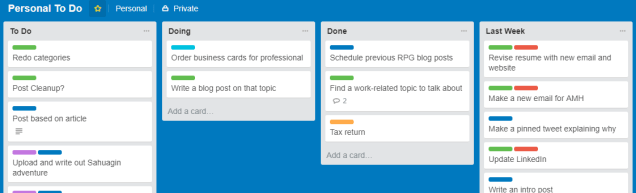
Since I wanted to do a new redesign, make a new blog, and in general do a full “rebrand,” I needed some way to keep track of it all. Given that I only need something for my own tasks, I wanted something simple and free that I could manage anywhere, thus I turned to Trello.

Screenshot 2018-03-18 20_10_13-Personal To Do _ Trello
My task board

For those who may not be familiar, Trello is a simple task management tool that simulates the “Kanban” style of workflow: In this case like note cards moved around on a board, with what column they’re in representing their status.

For my board, any new task goes under “To Do,” and tagged with a Label (those colored bars on the card) indicating category (e.g. which blog it’s for, if it’s for real-life, or important). The things that I am to have done in the next day or so gets moved into “Doing” so I know what my short-term goals are. Once they’re done, they get moved to the next column and stay there for a week.

The final column, “Last Week” isn’t very necessary, but does give some perspective. Every week, I’ll move all the tasks that I got done over one column to the final one. This way, I can see both what I accomplished, and how it stacks up to the current week’s status. This helps me to stay motivated to complete these sort of “intangible” tasks, where there’s no concrete benefit to doing them.

Having some way to stay organized is really important so that tasks don’t get lost. Trello works well for me, but I’ve also found Google Keep useful if you need more of something that’s easy to put into a checklist, or a Calendar app if there’s a lot of tasks that have to be done on a timed basis.

Rebranding

If you have an old link, you may be confused: “What about ‘Yeah, But Hats?'” I’ve decided that name didn’t work for a number of reasons. Namely, somewhere around the tenth person to look at the web address in all lower case and ask: “Yeah But That’s?” Oops.

So! Here’s the new web address. It better reflects my professional role now, as I have been steadily branching out to cover more gaps in a small team. As such, this blog will start getting posts more in line with development and workplace subjects.

If you’re new here, welcome! I appreciate you taking the time to visit me here and see what’s going on. If you’ve been with me for a while, thanks for sticking around through the rebranding, and I hope you’ll find the new content worth reading.

Jira Training – Day 1

Today begins a three-day Jira training, run by Steve Terelmes of Expium. I’ve spent a lot of time digging through various settings and configurations in Jira but, while I’ve discovered a lot of what it can do, thought it best to do an actual training. This way, we have a fully-trained (and possibly later certified?) person that can spread knowledge to the rest of the company.

The morning was mainly focused on high-level user management, including groups and permissions and adding admins. Then it moved to customizing the Jira instance visually, changing the image or colors, and really just how to set it up to make it your company’s Jira instead of just Jira.

Later in the afternoon, we moved into workflows, most of which I’ve already learned, but some information about the correct way to do it (statuses are where people do work, transitions are where Jira does work). As well as how to set up and configure the projects.

What I learned today

  • Difference between the Jira Projects
    Mainly that Jira Software and Jira Service Desk are the main important ones
  • Announcements on Jira
    Theoretically useful, but I’m not sure how useful I’ll actually find it
  • Proper naming conventions/thought processes for workflows
    I’d figured out most of how workflows work already, but having the proper guidance on the best was to use them, namely where to put the “verbs,” did help.
  • How to avoid making so many extra schemes everywhere
    This one’s the most important. When making a project, you can choose “Create with Shared Config” and then build out your schemes from there.

Overall, not a lot learned today, but its good for getting everything to a solid baseline. I expect the next day to be a lot more informative, but only because I have figured out most of today’s topics on my own already.

Maybe don’t do that in public (RPGs)

Last weekend, I was at a convention and played in the single worst RPG session I have so far played. Then, after lots of drinks and retelling how bad it was, I realized I haven’t said anything here about running RPGs. Thus, since I haven’t posted in months, I’m going to talk about running a game at some sort of convention, where you don’t know the players.

First: make sure your session fits in the time slot. Aim to take up no more than 80% of the available time, because your players will likely play slower and be less familiar with the system.

Related to that, keep the game moving. There’s table talk and there’s a 15-minute breakdown of the current Marvel movie trailer. Look for players that are not engaged with either the game or conversation to know when you need to guide people back. Likewise, don’t put an extended focus on one character. Again, a quick glance at the non-participating players can usually tell you when the scene has gone on too long.

If your players are struggling with a plan, it’s okay to point out obviously bad plans. Things their characters would know, like “traveling at night is dangerous and exhausting” are okay to point out if no one else says anything.

Make sure the action the player describes matches the action you’re assuming. “I’m going to keep watch” might mean to the player “I’m nearby but looking for threats”  but you may assume “I’m hanging back a football field away.” Ask for clarification as needed to avoid sidelining players.

Most important for a public game: don’t include controversial content. Generally, keeping content PG-13 is advisable. Keep in mind, people may have had to live through rape or serious abuse or a host of other very bad things. Don’t toss them into the session as a cheap way to up the stakes.

This last point bears repeating, especially because if you are running a scheduled game at a venue, you are implicitly representing them. You have presumably contacted them and offered to run a game. They have presumably given you a timeslot to do it. This comes with an understanding that you will not do something to make the place look bad. If you do not want this responsibility do not run an organized game.

If you instead think, “I’ll just run a pickup game,” that’s fine, but be aware that most of the same rules apply. Mainly, if your solution for avoiding having to moderate your content is to run an unsanctioned game, maybe just don’t run it at all.

Social Characters in Combat


When I play an RPG, I usually opt for a social character. Bonus points if they have magic (Sorcerers in D&D are my favorite).

Then I played other games that had more robust skills and less focused classes. Other players could be a Sword Guy, a Spell Dude, and the Healer Person. You could be the charmer, with a wit sharper than anyone else’s sword. The problem here is that line is not literal. What faced with someone with an actual sword, you tend to fall apart (that line is often literal).

What’s such a character to do? What’s a designer to do? You can’t have every situation (specifically, combat) be able to be talked out of, or the game suddenly becomes focussed on one character. Conversely, having nothing to do in combat can bore the social character. Sure they can have a weapon, but they’re likely not going to be effective with it. It would be like running through an anti-magic field dungeon and telling the wizard “you’ve got some daggers, you’ll be fine.”

Social characters do have something to do in combat, even if it’s not implemented. Shout the right insults, and suddenly now your target only wants to take you out. No longer cares about staying in formation, staying behind cover, that jerk who insulted his lineage must be stamped out.

So great! Now you have a very angry person charging at you, who wants you dead. Super. That’s not a problem; in fact, that’s great! In a gun fight, that means the idiot is probably out in the open. In melee combat, he’s broken out of formation. You may not be able to deal with this, but the rest of your team can.


The current idea for my RPG came about from the short story “Huxleyed Into the Full Orwell” by Cory Doctorow. In particular this line from the start:

Shandra was weirder, though. She’d thought up the whole demonstration, socialed the everfuck out of the news, rallied a couple hundred weirdos to join her in the chicken-farm, shouting impotently at the courthouse, ringed by cops scarily into their Afghanistan-surplus riot-gear.

Isn’t that cool? Just the idea of what you can pull using someone who’s skilled at social media and talking to people seems like an excellent mechanic. So, it got me thinking, for a modern setting:

What if you use social abilities as an analog for magic?

Let’s say you’re in a more modern, or in a near future setting. You’ve got to sneak into a building, without alerting the guards. In a fantasy game, the wizard might conjure something as a distraction. Here, you might summon a flash mob to the convenience store across the street using NeoTwitter. Later, your team gets injured. In D&D, your cleric heals them. Now, you give a short talk to rally them and let them push through the pain.

Over the past 10 or so years, things have gotten, well, werid, at least in terms of how we communicate. Not just in terms of media, but actually what our goals are in communicating. Everyone on social media has a “brand” and they use it to promote that “brand.” Your Aunt’s brand might be “1 Like = 1 Prayer” and talking about how much better things used to be before “They” ruined it. Your Nephew is posting Minion Memes and talking about Minecraft. You’re talking about RPGs on the internet like it’s your Job.

Even more interesting is how we discuss (read: argue) things. Stephen Colbert famously coined the word “Truthiness” for things that “feel right” instead of needing to be right. Isn’t that how many of us argue now? Many of us find someone to argue with, then make the points we want to, and feel satisfied. If they disagree, they’re clearly mistaken and must be corrected. You don’t have to be right, you just have to win.

Why not implement these into an RPG? Your brand and following is basically your caster level, as long as it’s limited to conjuration and divination. You get into a shouting match with the office front desk and by the time you’ve given them so much grief about “Why won’t you just let the server team do its thing? Should I call the CEO?” they just let you through because they’re tired of dealing with you.

WashingCon is this weekend, and I plan to go and test out some of these ideas with the RPG I’m building. Hopefully, I’ll get a chance to test it out.

RPGs: Who does what?

The last post talked about initiative systems. I’m going to use the same systems to talk about how actions shape encounters, so here’s a quick recap:

  • Ironclaw: Team-Based. The team that initiates goes first. Each team chooses the order of characters to act.
  • D&D: Character-Based. Order of characters to act is randomly chosen for the combat.
  • Shadowrun: Character-Based. As D&D, initiative is per round and higher initiative characters can have multiple turns in a round.
  • Arcanis: Active Time. Characters are on a clock, and actions advance that clock. Characters at the current “time” act.
  • ParagonActive Time.  Characters have a priority, that actions increase. Lowest priority characters act before higher characters.
  • Mouse GuardDeclare and Resolve. All sides declare their actions secretly, then actions are resolved.

I want to talk about Action Economies. Each system has different ways of expressing how a player gets to act when their “turn” comes up. Each system also handles actions differently.

Systems like D&D and Shadowrun lump their actions into different categories. Generally, things like attacking or casting a spell or some other “I do a thing to someone else” action is considered more valuable than repositioning or interacting with an object. Thus, while players can generally “trade down” and move twice instead of attacking, generally this is only done when the “Major” or “Standard” action won’t fit here.

Ironclaw and Mouse Guard give their actions equal weight. All available actions are always able to be substituted for other actions, whereas in D&D you wouldn’t be able to substitute “interact with a door” action with an “attack that guy” action. Here, you can. This causes a new host of balance issues, where every action has to be balanced around every other potential action.

Arcanis and Paragon use the Active Time system, so they’re somewhat locked into balancing actions based on the delay they cause. Someone swinging a sledgehammer is going to take longer to act again compared to someone slashing with a knife. However, Captain Sledgehammer is going to be way more effective if he hits (ideally, slightly disproportionately more) than the knife-swinging slasher.

As a contrived example: The Knife attack may take 2 delay, and do 3 damage if successful. The Hammer may take 4 delay, and do 7 damage if successful. This is balanced. The Knife attacker may do less damage per hit, but has twice the opportunity to do any damage. The hammer user must have stronger hits, but quicker enemies may be able to constantly dart away before the hammer user can act again. Or: consider if an enemy has 9 health. The dagger kills it in 3 hits, which uses only 6 delay, where the hammer user kills it in only 2 hits but uses 8 delay.

This Economy of Actions is what makes encounters interesting.

Action Economics are Fun!

The way in which players decide what to do, what’s valuable, and what’s presently useful is what makes these encounters fun. Is dodging in D&D better than attacking? Maybe! If you’re surrounded by nothing you can disable, it’s probably better to live another round and Dodge and hope your party can assist. Has your monk gotten himself surrounded, again? You probably want to Attack and help him out (again). Shoving someone 5 feet away from you: probably less useful than attacking. Shoving someone 5 feet away from you off a ledge: probably better than attacking.

Where the game designer can shine is the available choices for the party. Sure, trying to Scare someone in Ironclaw might immediately end your turn and make you vulnerable to attacks, but that won’t matter if you terrify everyone into running away. Varying the power (more damage, potential to incapacitate) with the drawback (takes longer, possibility of being vulnerable) makes for interesting choices. Do I want to try and remove this guy from combat, knowing that if I fail I’ll be very vulnerable? It depends.

Players might have different philosophies on how they want to play. Some like high-risk high-reward. Others value consistency. Often, players want to access both. Sometimes the knife user needs an all-out attack to end it now before it ends them next turn. Sometimes the hammer player throws a quick punch to knock someone out so they can get back into the fight quickly.

The types of actions that the players can perform, and how often they can perform them, shapes how the system informs the narrative. The nimble rogue darting in and out slicing quickly with his dagger is more visible in Arcanis (more chances to act) than D&D (Standard action to attack, maybe a bonus action to off-hand strike). The raging barbarian shattering his enemies with raw fury is better shown in D&D (each attack crushing a foe) than Arcanis (more impressive hits, but less flashy due to the slower time).

What players want to do should be what they can do (within reason). The better a system can reflect that, the more the players will enjoy it.

What even are blogs

I’m bad at blogging. Last post was a year and a half ago. Since then, I’ve gotten a new job, I’ve started prototyping an RPG, I’ve done a small amount of tools development. Professionally, I’ve been trying to make Good Tools for Good Websites and generally make sure everything runs smoothly.

I’m going to try blogging again. Almost two years ago it was helpful to organize my thoughts using it, and now that I’m working more actively on my RPG I’m going to try it again. The next posts will be talking about tabletop RPG mechanics and why I find them interesting. Occasionally I might post about something like why I like React.js or some other software thing, but I have RPGs on the mind right now.