Rebranding

If you have an old link, you may be confused: “What about ‘Yeah, But Hats?'” I’ve decided that name didn’t work for a number of reasons. Namely, somewhere around the tenth person to look at the web address in all lower case and ask: “Yeah But That’s?” Oops.

So! Here’s the new web address. It better reflects my professional role now, as I have been steadily branching out to cover more gaps in a small team. As such, this blog will start getting posts more in line with development and workplace subjects.

If you’re new here, welcome! I appreciate you taking the time to visit me here and see what’s going on. If you’ve been with me for a while, thanks for sticking around through the rebranding, and I hope you’ll find the new content worth reading.

What’s the point of this meeting?

I’ve been trying to “reconfigure” some of the meetings for my team recently. Since I took over our primary web team, I realized there’s been a lot of things that I was maintaining but for no purpose. These were usually outdated processes that were started by someone that no longer works there or because of some rule that was assumed to be in place that actually wasn’t.

When I started looking into why some of these rules (e.g. “we can only deploy on Fridays after 6”) were there in the first place, I discovered that, for the most part, these processes were just utterly nonsensical. Taking the time to take a step back and evaluate whether or not we could improve these processes, I discovered that almost universally, we could.

This sort of Intentionality in running a team has proven so far to be beneficial. So, naturally, I applied it to meetings.

We’re a small team and all in the same room. We’ve got some customized Jira dashboards that tell us status and who’s working on what. All of us are aware of what’s going on with others, and blockers get brought up as they happen instead of the following day. Scrum’s not useful for a team for our size, so it’s out.

Pull Request reviews are good, but we can take some time on our own to review the PR before we meet. This way, a 20-minute discussion on the benefits of (a) => a+1 vs a => a+1 occurs asynchronously before the meeting instead of during it.

Sprint Reviews are theoretically useful, but questions like “so, what are your thoughts this week?” are not. Asking more pointed questions (largely inspired by the “Start, Stop, Continue” approach) like “Did you do anything new this sprint that worked well?” should help with making reviews more useful.

Changing meetings so that they are more likely to yield a more consistent result should be the goal of every person who runs meetings. No one wants to sit in a room for 2 hours arguing over the finer points of blue vs cyan when you just want this design approved. Think about the intentions behind meetings and how the questions and topics work towards those intentions. And maybe drop that meeting that doesn’t seem useful.

Keeping order

Since I wanted to do a new redesign, make a new blog, and in general do a full “rebrand,” I needed some way to keep track of it all. Given that I only need something for my own tasks, I wanted something simple and free that I could manage anywhere, thus I turned to Trello.

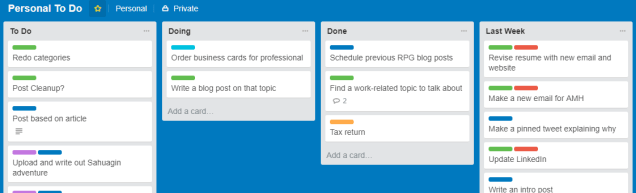
Screenshot 2018-03-18 20_10_13-Personal To Do _ Trello
My task board

For those who may not be familiar, Trello is a simple task management tool that simulates the “Kanban” style of workflow: In this case like note cards moved around on a board, with what column they’re in representing their status.

For my board, any new task goes under “To Do,” and tagged with a Label (those colored bars on the card) indicating category (e.g. which blog it’s for, if it’s for real-life, or important). The things that I am to have done in the next day or so gets moved into “Doing” so I know what my short-term goals are. Once they’re done, they get moved to the next column and stay there for a week.

The final column, “Last Week” isn’t very necessary, but does give some perspective. Every week, I’ll move all the tasks that I got done over one column to the final one. This way, I can see both what I accomplished, and how it stacks up to the current week’s status. This helps me to stay motivated to complete these sort of “intangible” tasks, where there’s no concrete benefit to doing them.

Having some way to stay organized is really important so that tasks don’t get lost. Trello works well for me, but I’ve also found Google Keep useful if you need more of something that’s easy to put into a checklist, or a Calendar app if there’s a lot of tasks that have to be done on a timed basis.

Jira Training – Day 2

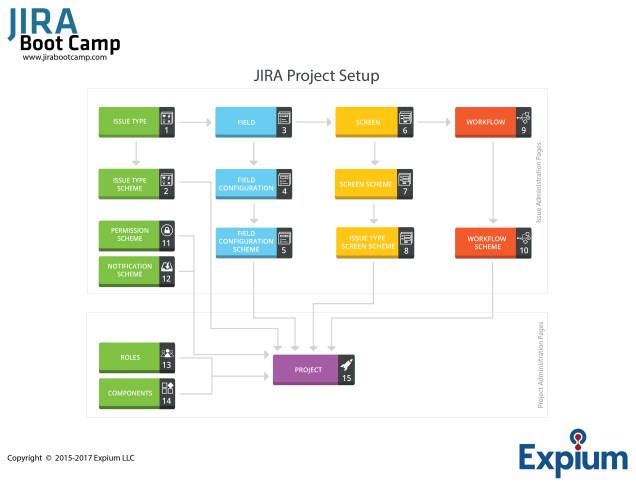
Day 2 was filled with a lot of issues. Mostly learning about them. We covered just about everything that issues could apply to that we didn’t cover on day one. Basically, everything except roles and components in this diagram has been covered.


f5d74dde380c83f868362671c286accb
More Diagrams provided by Expium here: http://jbc.expium.com/diagrams/


The training today was filled with everything about the issues. How they link, the difference between an Epic Link, Sub-Task Link, and other, “semantic” issue links. It covered searching for issues, adding custom fields, viewing those fields in various screens, and how to change field configurations.

The afternoon was mostly filled with one large workshop just configuring an entire project, with new and existing issue types, workflows, and screens. I ended up being a secondary instructor for some of the other people in the lecture, given my baseline understanding of how Jira works, so that those near me could complete the workshop.

What I learned today

  • Secondary fields on issues
    Votes could actually be pretty useful, and time tracking could maybe help as well, at least as far as debugging when a task has been forgotten as opposed to just being more difficult than anticipated.
  • Screens and how to associate them
    This was something I had sort of figured out already, but getting some more information on how to properly use and configure it was great.
  • Field Configurations are not user-friendly
    Using the descriptions for the Field Configuration itself is pretty necessary because of it.
  • Advice for Certification
    Certification may be a good thing to pick up for professional development, but it will also likely require more studying than I had originally anticipated.

Overall, today had a good mix of new vs old information, with a lot of it giving me good ideas on how we could potentially improve our own usage of it. I’m looking forward to the next day, which should be mostly new information, including some stuff that was alluded to (like transition control based on issue fields).

Jira Training – Day 1

Today begins a three-day Jira training, run by Steve Terelmes of Expium. I’ve spent a lot of time digging through various settings and configurations in Jira but, while I’ve discovered a lot of what it can do, thought it best to do an actual training. This way, we have a fully-trained (and possibly later certified?) person that can spread knowledge to the rest of the company.

The morning was mainly focused on high-level user management, including groups and permissions and adding admins. Then it moved to customizing the Jira instance visually, changing the image or colors, and really just how to set it up to make it your company’s Jira instead of just Jira.

Later in the afternoon, we moved into workflows, most of which I’ve already learned, but some information about the correct way to do it (statuses are where people do work, transitions are where Jira does work). As well as how to set up and configure the projects.

What I learned today

  • Difference between the Jira Projects
    Mainly that Jira Software and Jira Service Desk are the main important ones
  • Announcements on Jira
    Theoretically useful, but I’m not sure how useful I’ll actually find it
  • Proper naming conventions/thought processes for workflows
    I’d figured out most of how workflows work already, but having the proper guidance on the best was to use them, namely where to put the “verbs,” did help.
  • How to avoid making so many extra schemes everywhere
    This one’s the most important. When making a project, you can choose “Create with Shared Config” and then build out your schemes from there.

Overall, not a lot learned today, but its good for getting everything to a solid baseline. I expect the next day to be a lot more informative, but only because I have figured out most of today’s topics on my own already.

Maybe don’t do that in public (RPGs)

Last weekend, I was at a convention and played in the single worst RPG session I have so far played. Then, after lots of drinks and retelling how bad it was, I realized I haven’t said anything here about running RPGs. Thus, since I haven’t posted in months, I’m going to talk about running a game at some sort of convention, where you don’t know the players.

First: make sure your session fits in the time slot. Aim to take up no more than 80% of the available time, because your players will likely play slower and be less familiar with the system.

Related to that, keep the game moving. There’s table talk and there’s a 15-minute breakdown of the current Marvel movie trailer. Look for players that are not engaged with either the game or conversation to know when you need to guide people back. Likewise, don’t put an extended focus on one character. Again, a quick glance at the non-participating players can usually tell you when the scene has gone on too long.

If your players are struggling with a plan, it’s okay to point out obviously bad plans. Things their characters would know, like “traveling at night is dangerous and exhausting” are okay to point out if no one else says anything.

Make sure the action the player describes matches the action you’re assuming. “I’m going to keep watch” might mean to the player “I’m nearby but looking for threats”  but you may assume “I’m hanging back a football field away.” Ask for clarification as needed to avoid sidelining players.

Most important for a public game: don’t include controversial content. Generally, keeping content PG-13 is advisable. Keep in mind, people may have had to live through rape or serious abuse or a host of other very bad things. Don’t toss them into the session as a cheap way to up the stakes.

This last point bears repeating, especially because if you are running a scheduled game at a venue, you are implicitly representing them. You have presumably contacted them and offered to run a game. They have presumably given you a timeslot to do it. This comes with an understanding that you will not do something to make the place look bad. If you do not want this responsibility do not run an organized game.

If you instead think, “I’ll just run a pickup game,” that’s fine, but be aware that most of the same rules apply. Mainly, if your solution for avoiding having to moderate your content is to run an unsanctioned game, maybe just don’t run it at all.

Social Characters in Combat


When I play an RPG, I usually opt for a social character. Bonus points if they have magic (Sorcerers in D&D are my favorite).

Then I played other games that had more robust skills and less focused classes. Other players could be a Sword Guy, a Spell Dude, and the Healer Person. You could be the charmer, with a wit sharper than anyone else’s sword. The problem here is that line is not literal. What faced with someone with an actual sword, you tend to fall apart (that line is often literal).

What’s such a character to do? What’s a designer to do? You can’t have every situation (specifically, combat) be able to be talked out of, or the game suddenly becomes focussed on one character. Conversely, having nothing to do in combat can bore the social character. Sure they can have a weapon, but they’re likely not going to be effective with it. It would be like running through an anti-magic field dungeon and telling the wizard “you’ve got some daggers, you’ll be fine.”

Social characters do have something to do in combat, even if it’s not implemented. Shout the right insults, and suddenly now your target only wants to take you out. No longer cares about staying in formation, staying behind cover, that jerk who insulted his lineage must be stamped out.

So great! Now you have a very angry person charging at you, who wants you dead. Super. That’s not a problem; in fact, that’s great! In a gun fight, that means the idiot is probably out in the open. In melee combat, he’s broken out of formation. You may not be able to deal with this, but the rest of your team can.


The current idea for my RPG came about from the short story “Huxleyed Into the Full Orwell” by Cory Doctorow. In particular this line from the start:

Shandra was weirder, though. She’d thought up the whole demonstration, socialed the everfuck out of the news, rallied a couple hundred weirdos to join her in the chicken-farm, shouting impotently at the courthouse, ringed by cops scarily into their Afghanistan-surplus riot-gear.

Isn’t that cool? Just the idea of what you can pull using someone who’s skilled at social media and talking to people seems like an excellent mechanic. So, it got me thinking, for a modern setting:

What if you use social abilities as an analog for magic?

Let’s say you’re in a more modern, or in a near future setting. You’ve got to sneak into a building, without alerting the guards. In a fantasy game, the wizard might conjure something as a distraction. Here, you might summon a flash mob to the convenience store across the street using NeoTwitter. Later, your team gets injured. In D&D, your cleric heals them. Now, you give a short talk to rally them and let them push through the pain.

Over the past 10 or so years, things have gotten, well, werid, at least in terms of how we communicate. Not just in terms of media, but actually what our goals are in communicating. Everyone on social media has a “brand” and they use it to promote that “brand.” Your Aunt’s brand might be “1 Like = 1 Prayer” and talking about how much better things used to be before “They” ruined it. Your Nephew is posting Minion Memes and talking about Minecraft. You’re talking about RPGs on the internet like it’s your Job.

Even more interesting is how we discuss (read: argue) things. Stephen Colbert famously coined the word “Truthiness” for things that “feel right” instead of needing to be right. Isn’t that how many of us argue now? Many of us find someone to argue with, then make the points we want to, and feel satisfied. If they disagree, they’re clearly mistaken and must be corrected. You don’t have to be right, you just have to win.

Why not implement these into an RPG? Your brand and following is basically your caster level, as long as it’s limited to conjuration and divination. You get into a shouting match with the office front desk and by the time you’ve given them so much grief about “Why won’t you just let the server team do its thing? Should I call the CEO?” they just let you through because they’re tired of dealing with you.

WashingCon is this weekend, and I plan to go and test out some of these ideas with the RPG I’m building. Hopefully, I’ll get a chance to test it out.
Prototyping an RPG

I have actually started prototyping my Cyberpunk RPG. This is the furthest I’ve gotten on just about any personal game-related project since college and I’m happy to report that it’s kind of broken.

But that’s okay! It’s a playtest. I knew it was going to be broken (although I hoped it was less broken than it was). The point was just to get something out so I could at least start.

Here’s a list of likely features in the full game:

  • Cool Augments to customize your character (and their rolls)!
  • Hacking that makes sense!
  • Social media combat and interaction with the game world!
  • Super-fun Action-Point-based frantic combat!
  • Personalized talents to really show where your character shines!
  • Expandable abilities that allow for either Breadth or Depth in what you can do!
  • Abstracted health system to reflect the wear and tear of combat with different damage types!

Here’s what was in the prototype:

  • Some augments that boosted skill rolls.
  • A skill labeled “Computers”
  • “Hey, look, you can totally do some in-combat streaming. If you want. No? Okay.”
  • Actually pretty fun and mostly balanced Action-Point based combat
  • Vague rules for creating talents so I didn’t have to make a list ahead of time
  • Some examples of potential abilities that didn’t make it into the testing
  • A surprisingly functional abstracted health system to showcase different attack damage types.

So, of the 7: 2 actually got in and worked, 1 was totally absent, and the rest were partially implemented.

But how did the playtest actually go? Fairly well. The game is both fun and functional, but there are some problems with it.

What did I learn?

Numeric balancing

Just because the numbers are balanced against each other, doesn’t mean they are fun. Stats were far too strong, and it took me 3 playtests to figure that out. When your highest stat can give you a +7, and your highest skill proficiency can give you a +5, there’s really no point in boosting your skill that relies on a stat of +2. If you can summarize a character as peaks and valleys, all of the characters were basically three mountains sitting on some rolling plains.

Creativity is hard without guidelines

Remember that bit about the talents? Every playtest, someone suggested that I make a list of examples when players need to create something themselves. Which, admittedly, I knew I needed to happen. When your instruction is “Choose a skill to get a bonus is a narrow situation” the definition of “narrow” is poorly defined. Can I get a bonus to shooting while aiming? How about with pistols? What if there’s a guy with no one near him? Having some examples to show the standard “narrow” limit would have helped this problem immensely.

Changing the central roll mechanic

I had a cool idea. Each character had an essence die that gets added to all rolls which started as a d12. This would shrink one die size for every augment they took, but the augment would both give bonuses to 1 or 2 skills, and change those skill to use a more stable 3d6 instead of a more swingy d20. The idea being the machine would perform consistently where a human would have wildly different results, both good and bad.

This was a nightmare that I could never balance properly.

Sure, the mechanic was interesting, but it either was underpowered, and nobody took augments or overpowered so that people would take 1 augment and be sitting at insane bonuses plus a d10 to roll. Despite this, I still think I can get it to work.

The solution could be one of the following:

  • Augments get a reverse-essence bonus, where the lower your essence die is the more powerful the augments get.
  • Augments tag skills and instead give you abilities.
  • Keep the system as-is and overhaul the numbers and re-balance based on the new numbers.

Just start. Anywhere.

I’d been hemming and hawing over whether or not this is ready, and then decided the best way to run it was to tell my friends that we were running a “Mystery RPG” (that is, an RPG that is a mystery and not a mystery-themed RPG) and just playing. A base system was created in about a week with other rules being created on the fly. Just running the game was the most helpful way to make progress. Even if it’s terrible (which it might be), even if it’s broken (which it will be), you won’t know until you see the parts moving and working with each other. A game you can play is always going to more fun than a game you can’t, so just make something and run it.

I forgot about the Star Wars RPG

I am kicking myself for forgetting about Fantasy Flight Games’ Star Wars RPG: Edge of the Empire (also Force and Destiny and Age of Rebellion, but EotE is my current favorite). I’m going to talk about it in the context of the last two posts about initiative and action economies.

SWRPG’s Funky Dice

Going into this game requires a brief explanation about the dice. The dice are proprietary, with symbols instead of numbers. These dice Successes which get matched against Failures (to see if the task succeeds) and Advantages against Threats (to see if any bonuses or twists happen). Higher stat/skill values either give more dice or replace dice with better dice.

Initiative

EotE uses a character-based turns but doesn’t limit that slot to the character. Each character rolls their dice, totally up their successes (with advantages as tie-breakers). The GM orders the initiative slots based on which team they’re on (generally PC vs NPC). The players then get to choose the order they act within those slots (which can change from round to round).

This ends up with the best of both Team and Character based initiative. Rounds generally aren’t a curb stomp of whoever went first (since there’s a mix) but characters generally get flexibility in how they’re able to act within a round (unlike systems like D&D). This is probably the best turn-based initiative system I’ve used.

Actions

Similar to D&D, with a standard Action, but instead of a Move there ends up being Maneuvers. These can be used to do combat-oriented quick tasks in addition to moving, like aiming or opening a door. Interestingly, it’s possible to get either a free Maneuver as either a side effect of an action (usually involving rolling advantage) OR spending strain (which is used for other abilities) to gain a second one.

This action economy, like Ironclaw’s, supports the cinematic flair that this system is trying to effect. It’s relatively easy to teach and explain (Actions make you roll; Maneuvers don’t).


This system is my favorite Narrative-based system. Other narrative systems are generally too loose with the rules, to the point of being overly vague, but this handles almost every aspect of it in an elegant way. There are a lot of good ideas to look at here for any GM who’s trying to build their own system, or even just looking for inspiration for their campaigns.